
Implementation is a lifecycle, not an installation.
It involves people, processes, documentation, logistics, technology and government coordination. Our execution model covers every stage in sequence.
The complete project lifecycle, in sequence.
This integrated approach helps reduce coordination gaps and enables smoother execution across multiple project stages.
What happens at each stage
Each stage has its own deliverables, its own stakeholders and its own failure modes. Here is what we take responsibility for.
Pump Selection
Coordinating pump selection against the approved project requirements and allocation for each selected farmer.
Farmer Coordination
Working directly with farmers so specifications, documentation and project requirements are understood and completed.
Farmer Share Collection
Facilitating collection of the applicable farmer contribution, with follow-up until the payment formalities are closed.
Site Survey
Assessing accessibility, water source, panel placement, existing infrastructure and installation feasibility, with photographs and records.
AIF Registration
Coordinating and completing AIF-related registration and documentation as applicable to the project.
CIF Registration
Facilitating CIF registration and related coordination so the project progresses through the prescribed process.
Warehousing
Material receipt, warehouse coordination, inventory tracking and dispatch planning against the installation schedule.
Logistics
Transporting solar pump systems and associated material from warehouse locations to the designated installation sites.
Site Installation
Pump and module installation, structures, electrical connections, controller installation, testing and commissioning.
INC Uploads
Submitting post-installation documentation, site photographs and supporting records through the applicable systems.
DREO Approval
Coordinating inspection and approval of completed installations with the concerned authorities.
Project Closure
Documentation, approvals and payment-related processes through to collection and closure with MPUVNL.
Most delays are coordination gaps, not technical ones.
A pump rarely stalls because of the hardware. It stalls because a document was incomplete, a survey was not shared with the installation team, material arrived before the site was ready, or an approval sat waiting on a file.
Because we hold every stage, handovers happen inside one team rather than between vendors. That is the practical difference a single-window model makes.
- One point of contact for project status at any stage
- Survey findings reach the installation team before mobilisation
- Documentation prepared alongside the work, not after it
- Approvals and payment processes followed through to closure
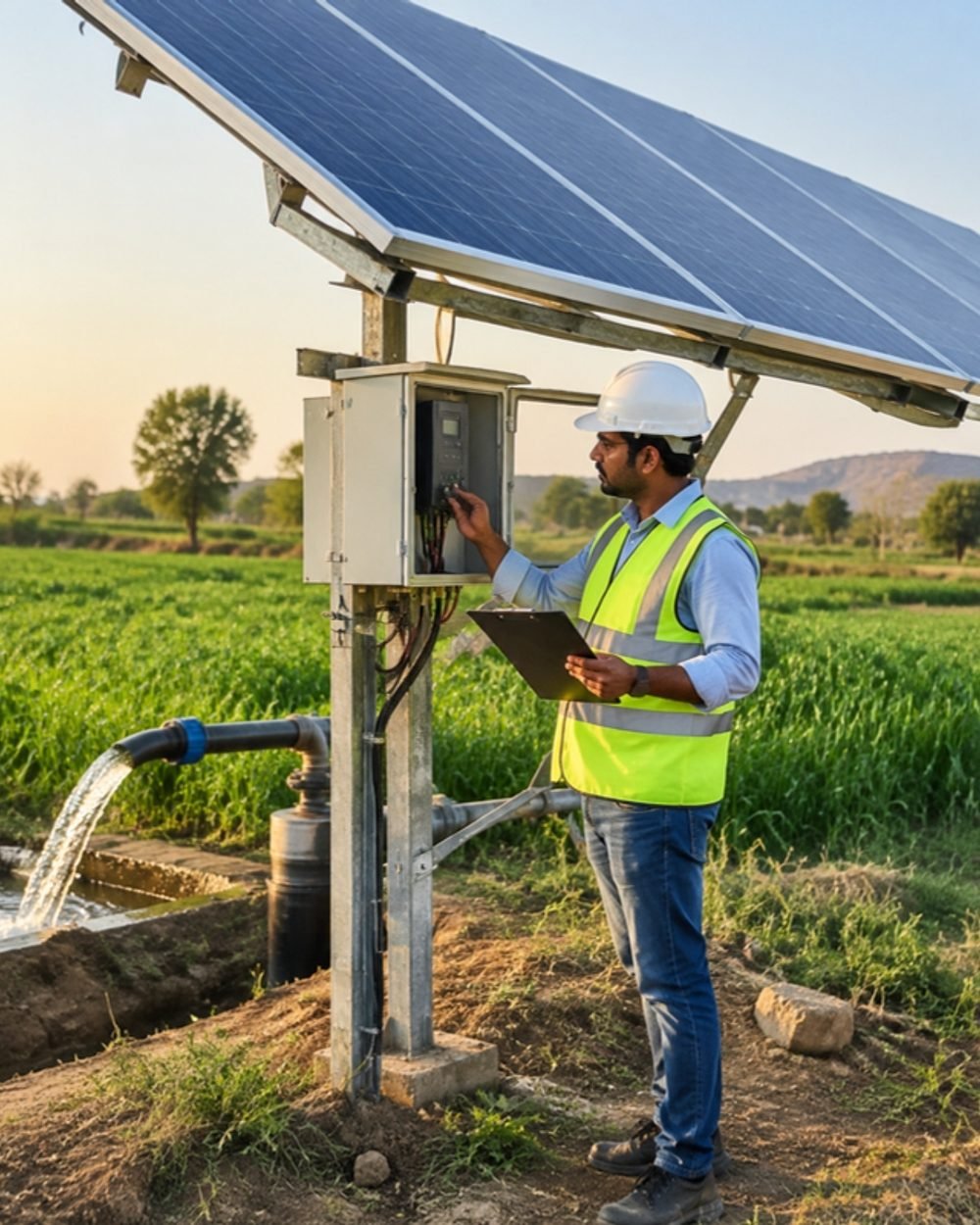 One team holding every stage, from survey to closure
To make every stage of solar pump implementation easier to coordinate, execute and close.
Our Mission
Looking for a reliable solar pump implementation partner?
Tell us about your project — geography, volume and the stages you need covered — and our team will come back with a clear execution plan.